
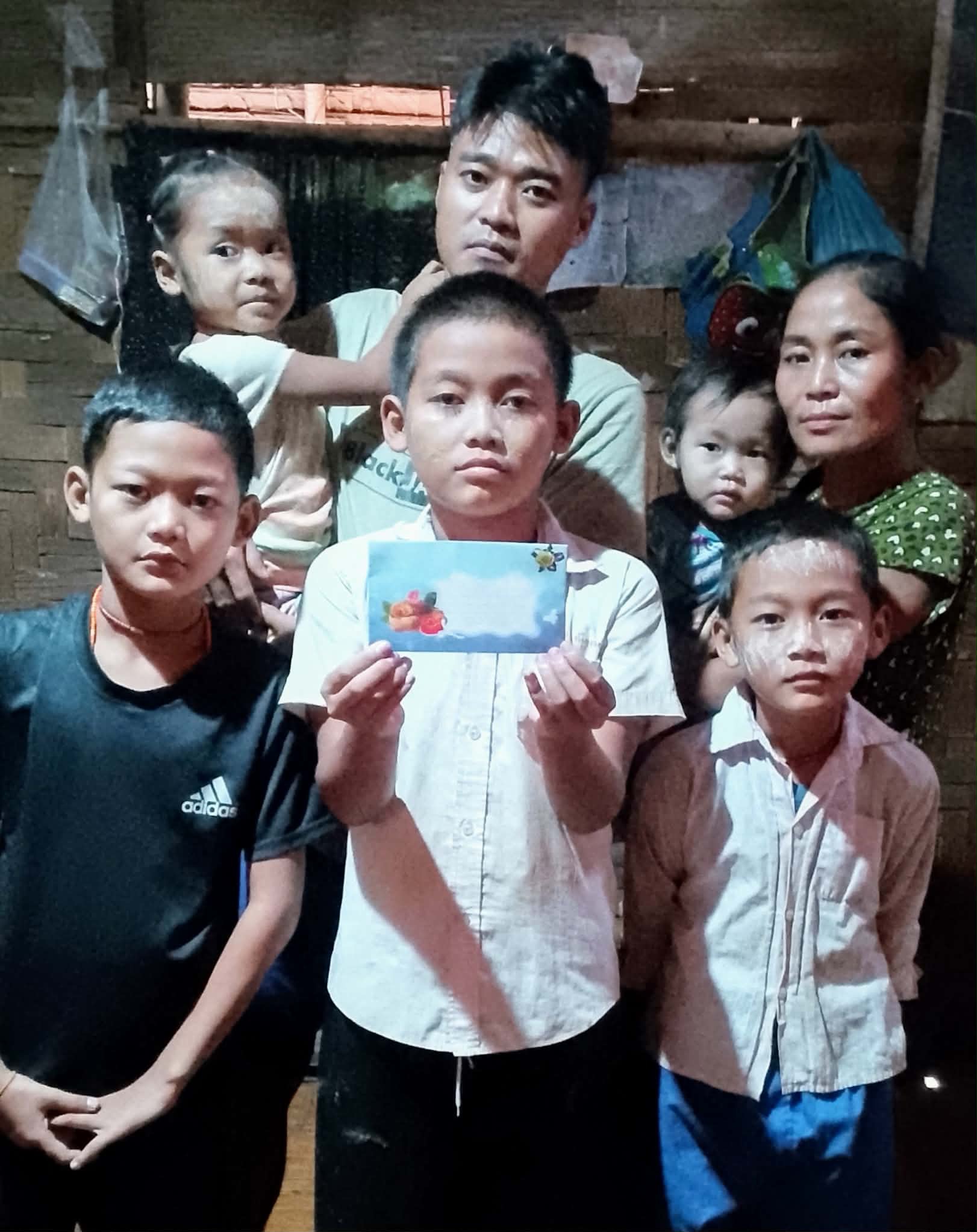
Photo Caption: The Moo Family, shown here, who lives inside Mae La Oon refugee camp, received funds last week from Radical Love and Chris ta eh Poe
CHRIS ta eh Poe lived his whole life in the refugee camp; his family fled war and persecution. Two years ago, Chris and his family arrived in the U.S., just weeks before the borders closed and U.S. Aid was withdrawn. Refugees in Chris’ camp – and around the world – now struggle with lack of food, medical supplies, and daily living needs.
Last week Chris, age 20, sent $200 to help the Moo Family (pictured above), who is in dire need in his same refugee camp. Radical Love added to the funds, which will help the family to buy rice, medicine, and supplies.
In 2024, Radical Love sponsored two families to come to the United States through an initiative created by the US State Department. We completed very detailed applications, raised needed funds, and built a team to support the arriving families. Chris’ family (The Poe Family) arrived December 19, 2024. The second family (The Moo Family) was delayed in coming; Mrs. Moo was pregnant and unable to fly in December. The Moos were told they would depart after the baby’s arrival, but when the U.S. borders closed to all refugees in January 2025, the Moos were stranded. They continue to be stranded in Mae La Oon, a refugee camp of nearly 10,000 people on the Burma/Thailand border. According to UN data, there are approximately 100,000 refugees in 9 camps along this same border.
Mae La Oon has sheltered refugees from Burma for four decades, many, like the Poes and the Moos, are of the Karen ethnicity – forced out by civil war in Burma. The refugee camps are sustained almost entirely by international donors. The United States cut its aid to Mae La Oon camp by 83% in 2025, leaving people struggling just to stay alive.
In an effort to help, Thailand began authorizing a portion of the camp’s refugees to work in their country. “The conditions of this work are dangerous,” shares ChiChi, Radical Love’s Outreach Coordinator and sister to Mrs. Moo. “Some people leave for work and they never come back. So I tell my sister to stay in the camp, and we will send money so you can eat and feed your children.”
Getting the funds from the United States to Mae La Oon is a process that involves wiring the money to a trusted family member in Bangkok, who travels for two days to get to the refugee camp. Because of scarcity, the family must be very quiet about having money (robbery and violence in the camp has increased as the supply of food and supplies has dwindled). When they receive funds from Radical Love and U.S.-based family, the Moo Family discretely shares it, helping feed and supply neighbors around them.
A “refugee” is a person who has to flee their home country because of war, violence, or persecution. It is not safe to return home, and they have no permanent home to go to. According the UNHCR, there are 41.6 million people classified as refugees globally this year.
Passed by bipartisan support, the “Refugee Act of 1980” established the modern U.S. Refugee Assistance Program and created annual “refugee ceilings” – the maximum number of refugees the U.S. can admit in a fiscal year. The President sets the ceiling each year. In 1980, the ceiling was 207,116. In 2026, the ceiling was 7,500 – the lowest in U.S history. The ceiling for 2027 was recently announced to be 17,500, with most slots reserved for white South Africans.
Refugees coming to the United States go through an extremely rigorous process, which includes interviews and background checks conducted by the FBI, the CIA, and the United Nations. Medical checks and several interviews follow. This process can take 2-3 years.
Organizations like World Relief help establish refugees after they’ve been selected; this includes picking them up from the airport, helping find initial housing and their first jobs. Refugees are expected to begin work almost right away; they must repay their entire travel loan to get to the U.S., along with rent, food, clothing and transportation.
Chris and his family (the Poes) have been in the U.S. for almost 2 years and are now living independently. Mr. Poe, Chris, and his brother work 5 days a week at a local factory, while the younger 2 Poe children attend school. Mrs. Poe is learning English and helping to care for others in the community. The family attends church weekly and is at every Radical Love event.
Radical Love works to create a welcoming community for refugees from around the world; we are now a trusted friend to over 500 resettled refugees in St Charles, Geneva, Batavia, Aurora and Montgomery. Refugees are driving to Radical Love events from Rockford and Chicago because “Radical Love makes me feel like I’m a part of something; I feel like I am home,” shares Maria, a refugee from Congo.
“For now, we pray. And we trust God. He makes all things possible, and we see His good everywhere,” shares ChiChi in the face of so much sorrow and waiting within her own family.